Jan 22, 2014

B2B Update 1/22/14

Mestre Acordeon and Mestra Suelly's B2B group, bicycling from Berkeley to Brazil, is in Oaxaca, or has just left, heading south. Acordeon and Suelly, both capoeira masters, are old friends of mine, and although I have never been a capoerista, I have great respect for the art form. One of these days I'll put up a post about my years playing music with Acordeon (aka Bira Almeida). 

The B2B project will document regional capoeira practices and music at their stops at the many capoeira schools that they will visit in their year-long trip from California to Brazil.

Here's a gig story from my days playing with Bira, previously posted here. 

You can get some sense of their project at these links:

B2B Facebook page

Rider blogs:

http://sabbaticalbike.org/
http://onegameonetime.blogspot.com/ (some nice essays from B2B rider "Pirata" - recommended)
http://marianopedals.blogspot.com/
http://b2bxb.tumblr.com/

Jan 1, 2014

Review: "Kansas City Lightning: The Rise and Times of Charlie Parker," by Stanley Crouch

“Long-awaited” is the descriptive term that reviewers repeatedly attach to Stanley Crouch’s new biography of Charlie Parker, "Kansas City Lightning." Beginning in the early 1980s, Crouch taped interviews with a number of Parker’s early associates, including Bird’s first wife, Rebecca Ruffin; Jay McShann; Buster Smith; Gene Ramey; and many others. Finally, in 2013, Crouch organized this material, along with previously known Parker history, into "Kansas City Lightning," which covers Parker’s life until about 1940. A second volume is anticipated.

However, Crouch was not content to produce a simply factual biography.

The reader will be immediately struck by two aspects of this book that one would not normally expect from a biography: First, the writing style that Crouch chooses to employ is not just florid, but over-the-top florid, in a vernacular idiom, often in street talk. Secondly, the narration often veers away from biography, into tangential historical material (e.g., railroad history; Jack Johnson; Sherlock Holmes; Chicago gangsters; American music from minstrels to ragtime). It’s enough to make most reviewers wonder what the heck Crouch was trying to do.

Check out these excellent reviews. You can feel the effort the reviewers had to expend, to make sense of Crouch’s mode of narration:

Matt Schudel, in The Washington Post


Dwight Garner, in The New York Times

Here’s my take: Crouch's digressions are obviously meant to put the biographical details into a comprehensive cultural/historical setting. The real significance of Parker’s life story is in the context of American culture. It goes in both directions: Understanding his world helps us to understand the development and significance of his art. At the same time, his art has taken its place in the ongoing development of our present cultural world.

Why the over-the-top florid writing style? I think the explanation is in an NPR interview that Crouch gave with Tavis Smiley: 

Crouch: ...there always is a bittersweet version of an epic hero in mythology. Charlie Parker is as close to a super hero as someone can be because the way he could play was on a super hero level. But that didn’t mean that he was a perfect person because Odysseus, Achilles, all of these people, they’re very gifted, but they’re also very screwed up [laugh]... 
The key here is Crouch’s analogy of Achilles and Odysseus to Charlie Parker. Today we see Charlie Parker as a nearly mythical figure - a “super hero.” The interviews that Crouch collected are as "factual" as reminiscences could be, fifty years later. Crouch, while presenting this "factual" material (OK, he does seem to invent some dialog, and often presumes to describe Charlie’s thoughts), sets himself up as an epic bard (like Homer, or maybe a Kansas City old-timer), and chooses his narrative voice appropriately. I’m sure Crouch knew that this would annoy some readers and reviewers, but if you look at this book as a long yarn spun by a colorful storyteller, it makes a very entertaining read. 

As far as nut-and-bolts musical analysis goes, this book doesn’t have a lot. Musicians will find better specific information in the biographies by Lawrence Koch (Yardbird Suite) and Carl Woideck (Charlie Parker: His Music and Life). Crouch does include some nicely written descriptions of the creative process in jazz, that are accessible to the average reader. As well, he explains the influences of Lester Young, Buster Smith, and Chu Berry on Parker’s style in layman's terms.

Although Stanley Crouch is a musician (drummer) as well as a writer, he does not always nail it, when it comes to the saxophone. I can say this, because I’m a sax player. For example,

“[Charlie] had long since mastered the physical challenges of playing - the pain of the lips, the tongue, and the teeth; the fatigue of the fingers, and the limitations of the lungs...”
As someone who has been playing for over 50 years, and taught many hundreds of students, I can assure you that this passage is more than a little overstated. But of course, it’s really just Crouch’s chosen prose style. There were a few other questionable saxophone-related statements that perhaps should have been fact-checked - but these are minor quibbles.

This book is a must-read for anyone who wants to understand how Charlie Parker went from being a clueless kid to becoming the brilliant creator of a musical style that is still fundamental to jazz. It’s quite informative, written from a unique perspective, and a lot of fun, if you are willing to accept Stanley Crouch on his own terms.


Link: Stanley Crouch bio on Wikipedia

And Happy New Year!

Dec 26, 2013

Chord Terminology: Dm7b5, Dø7, or Fm6?

"Minor 7 flat five," "half-diminished," or "IVm6"?

These three progressions all express pretty much the same thing, II V I in the key of C minor:
Dm7b5    G7b9    Cm
Dø7        G7b9    Cm
Fm6        G7b9    Cm
One of my first jazz teachers felt that the most accurate way to notate the first chord in this progression would be "m7b5," rather than "half-diminished." His reasoning was that its usual function had more in common with m7 chords than it did with diminished chords. That made sense to me then, and still does now.

The m7b5 chord is usually encountered as II (dominant preparation) in minor, as in the examples above. In major keys, II is a m7 chord. So in C major, II would be Dm7, and in C minor, II would be Dm7b5. It makes sense to use similar terminology - m7 and m7b5 - to describe similarly functioning chords.

The m7b5 chord is often called "half-diminished" because of its construction: diminished triad, with a minor seventh. It's only one accidental away from a "fully" diminished seventh chord. But these chords are not functionally related: The "fully" diminished seventh chord does not occur as a II (dominant preparation) in either major or minor. Rather, it virtually always functions as either a dominant chord (Bdim7 = G7b9 minus the root), or as a passing chord (supplying chromatic passing tones between two other chords). Here are two common turnaround progressions illustrating these usages:
Cmaj7   C#dim7   Dm7   G7    (here the C#dim7 has a dominant function, substituting for A7b9 as a V of II) 
Em7   Ebdim7   Dm7    G7    (here the Ebdim7 is a passing chord)
It's true that a m7b5 chord could serve as a dominant 9 chord minus the root (Bm7b5 = G9), but you'll rarely see it used that way in jazz lead sheets.

It's also true that you will sometimes see the m7b5 chord used in a sort of "passing" context in what I'd call an extended turnaround:
F#m7b5  Fm7   Em7   Ebdim7  Dm7  G7   (e.g., Cole Porter's "Night and Day")
Or sometimes as a VII in major, as part of the "circle within a key" (diatonic circle of fourths):
Cmaj7  Fmaj7  Bm7b5  Em7  Am7  Dm7  G7  Cmaj7
And yes, it's quicker to write a circle with a slash through it (or type option - o) than to write "m7b5."

But I'd still argue that "m7b5" better describes this chord, given its most common function.

In older fakebooks, you'll often see m7b5 expressed as a IVm6 chord:


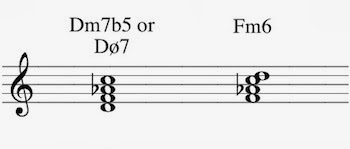
As you can see, Fm6 is an inversion of Dm7b5; the only difference is that Fm6 implies F in the bass rather than D. In the context of a progression like  Fm6  G7b9  Cm, Fm6 has the same "dominant preparation," minor-key function. Most modern fakebooks would relabel this chord as Dm7b5 (or Dø7), making it easier for players to recognize it (and deal with it) as part of a II V.

In his autobiography To Be, or Not...to Bop, Dizzy Gillespie credits Thelonious Monk with showing him how to use a "minor sixth chord with the sixth in the bass." Of course, voicing it this way gives you exactly a "minor seven flat five."

In current usage, you are more likely to see minor 6 chords occurring as I or IV in a minor key, or as IVm in a major key (e.g., Fm6  Bb7  Cmaj7, where the Fm6 and Bb7 are "borrowed from the parallel minor," adding temporary minor color via the notes Ab and Bb). 

I don't want to digress too much. But the next point of discussion might be: In the progression  Fm6  Bb7  Cmaj7  (or  Fm7  Bb7  Cmaj7), is the Fm6 (or Fm7) just a substitute for Dm7b5, as mentioned above, and is Bb7 just a substitute for G7b9 (e.g., see the bridge to "Stella by Starlight," where bVIIdom sustitutes for V)? One might make that argument, at least on the level of "dominant preparation, dominant substitute, tonic." However, the "IVm bVIIdom" formula tends to occur in specific harmonic situations, and I see it as a rather different thing.

Dec 22, 2013

More About "The Preacher"

Eric Stevens sent in some historical info about Horace Silver's "The Preacher," as an addendum to my last post:
According to [my] memory... 
In the early 60s Charlie Russo cut it as THE PREACHERMAN, as you may know. His mgr made him claim authorship; it got near the top, so Steve Allen and Ray Anthony cut it, big band. Then it hit the fan! Horace should’ve let it hit # 1, but sued too soon, and Russo & the disc were pulled. They first needed a B side, & I played bass on THERESA.
Well, I hadn't known that. Charlie Russo's "Preacherman" is on YouTube, but unfortunately not "Theresa."


Eric Stevens is a talented and prolific songwriter - here's a link to his website:  http://www.ericstevensmusic.webs.com/

Thanks, Eric!

Addendum 2/8/14: Here's a news clipping from 1963:


The original article is here, in a Dorothy Kilgallen showbiz gossip column.

Dec 15, 2013

Roots Jazz: Horace Silver's "The Preacher," and Clark Terry's "One Foot in the Gutter"

I've always dug Clark Terry's gospel-flavored tune "One Foot in the Gutter." I thought I had discovered something when I figured out that you could quote Stephen Foster's "Old Folks at Home" over the whole tune; it fits the chords perfectly. However, according to Robin Kelley's biography of Thelonious Monk, "One Foot" is actually based on the chords to "We'll Understand it Better, By and By." Here are "One Foot" (starts at 4:40 in the first video below, second tune on the album), and "We'll Understand it Better":


Still, "One Foot" has a bridge which does in fact fit the bridge to "Old Folks at Home," while "We'll Understand" doesn't have a bridge. But, on to the next subject.

Here's Horace Silver's "The Preacher," recorded in 1955, originally issued on the album "Horace Silver and the Jazz Messengers":


I don't think it's out of line to observe some striking similarities, both in the melody and the chord progression, between "The Preacher" and this old American tune (Julian Lage on guitar, John McGann on mandolin):


There's only about one spot where the chords don't correspond (bar 9).

Here's a link to the first printed version of "Railroad" (1898), here titled "Levee Song." The familiar part starts halfway down the first page. Note the last bar on the first page, a B triad moving to a C triad. That's kind of a telltale spot, occurring also in "The Preacher" (different key, of course).

But wait, there's more! Here's Nat King Cole with a classic advertising jingle from the 1950s:


Just one more, then I'll stop, I promise:


Dec 8, 2013

A 6-key Clarinet

Some years ago, I think in the late 1980s, one of my students (Eric, an eighth grader), said, "My grandpa's been fixing up an old clarinet. Do you want to see it?" I said, "Sure, bring it in next week." I was expecting a junker, or maybe an Albert system clarinet from the early 1900s, or...whatever.

At his next lesson, Eric brought in a cardboard mailing tube, and pulled out an instrument that looked like a recorder (German blockflöte or English fipple flute) but had a few keys, and a clarinet mouthpiece. It was a clarinet, but obviously a very early one. Grandpa (Doug) had filled a hairline crack, replaced the string windings that this instrument had instead of tenon corks, and replaced the pads. He had used felt for the pads, probably because the original leather ones were so deteriorated that they looked like felt to him.

The clarinet had 6 keys. I recall them this way: a register key, an A key, a RH little finger Ab/Eb key, and LH little finger keys for E/B and F#/C#. These keys had a flat, square area to hold the pad. A sixth key for LH C#/G#, differently shaped with a round area for the pad, had apparently been added later. The mouthpiece was ebony, with grooves to hold the string that was used in those days instead of a ligature. The mouthpiece tip, unfortunately, was broken. The clarinet was made of boxwood. It had a stamp on it that had a not-quite-legible maker's name, and "Paris."

I talked with Doug. He said that the instrument had been in his family at least since he was a kid (probably in the 1920s), disassembled, in bad shape, in a cigar box. His parents would say, "Now don't throw that away - that's a clarinet!" Doug kept it, and finally one day when he was much older, he decided that it was time to fix up that old clarinet. He was a fix-it kind of guy. So he did what seemed right, then sent it in with Eric.

I asked around, and found an early-music expert at Stanford who told me that 5-key clarinets were standard from around the 1750s until as late as the 1820s, and that the 6th key was often added to 5-key instruments in the early 1800s. I wondered how long that clarinet had been in Doug's family, and how it made its way to California (I never found out). The Stanford guy sent over a piece of leather that would be the appropriate material for pads. Doug used it to replace the felt pads. Then he bought a little block of ebony, and carved a new mouthpiece. It looked right, but of course it's a fine art to make a mouthpiece, and it didn't play. So he went to the next solution - he turned a new barrel on his lathe, with a diameter on one end to fit the clarinet, and a diameter on the other end to fit a modern mouthpiece. Now it was playable.

It seemed to play in the key of C (although in the 18th and 19th centuries, tuning standards varied wildly - see this Wikipedia article). Doug loaned me the instrument for six months. There was just one condition: I would learn to play it, and record something for him to listen to. What a privilege! I found a fingering chart somewhere, and eventually recorded him a couple of simple Handel pieces. The clarinet had a nice sound, but without the volume or projection of a modern instrument. Fingerings were of course not quite the same as a modern clarinet. Above high C, though, Boehm fingerings seemed to work. One problematic note was second-space Ab. The best I could find for that was to press only the register key - pretty stuffy, and out of tune. This instrument gave me an appreciation for what it took to play those Mozart and Stamitz pieces, in the era that they were written.

If Eric is out there somewhere and happens to read this, please leave me a comment!

Links:

Here's a nicely written up history of the development of the clarinet.

For some pictures of early clarinets, and current prices on antique instruments, here's one place to browse. The 14th and 20th ones down from the top of the page (#4611 and #4580) resemble the one described here.