Jun 21, 2023

Billie's Bounce - What are the right notes?

Comparing versions of “Billie’s Bounce”

Charlie Parker’s blues “Billie’s Bounce” is a staple in the jazz repertoire. Most jazz musicians know it well, and it has been recorded by dozens of legendary players. It appears in many fake books. Comparing recorded versions by Parker and others, and comparing with various print versions, there are disagreements on a number of details. How should this tune really go?


I became interested in this project after reading an article by Henry Martin in Music Theory Online, discussing Parker’s compositional techniques. The article included an image of a lead sheet in Parker’s hand titled “Bill’s Bounce” from the 1945 copyright submission, deposited at the Library of Congress. This chart was significantly different from the way I had been playing this tune for many years, and also did not match the most widely-known print versions - those in the Real Book Vol. 2 and Charlie Parker Omnibook.


To clarify Parker’s intentions, one primary reference has to be the Savoy master, which was the last of five takes recorded on November 26, 1945. This would have been the only available reference for most earlier musicians, until the other four studio takes were released by Savoy in 1956. 


The Library of Congress lead sheet in Parker’s hand is significant, but perhaps not definitive. It does not completely match Parker’s recordings. It would not have been known to most musicians of the last 70 or so years (although it would have been available, had anyone cared to ask).


Other significant references are the other four Savoy takes recorded that day, and also three live Parker recordings from 1946, 1950, and 1951. The live recordings have poor sound quality, and different transcribers may hear them differently. Indeed, even the Savoy studio recordings are heard differently by various transcribers.


Less significant, but definitely interesting, are various print sources. Each represents a (sometimes anonymous) transcriber’s hearing of the tune. Fake books have been a major influence in disseminating “common knowledge” versions.


My thanks to Henry Martin for his comments and suggestions, and to Carlos Ribas, for spectrum analysis of some notes in the recordings.


My proposal for a "correct" melody is at the end of this post.


Points of difference 


Points of disagreement between various recorded and print sources are shown below, on a re-charted copy of Parker’s Library of Congress manuscript. Title, chords, and other features, including octave changes in m.6 and m.11, are copied exactly from the original manuscript.


  1. m.1 beat 2+, G or G#
  2. m.1 beat 4, D or Eb
  3. m.3 beat 4, eighth note D on 4+, or not
  4. m.4 beat 2, turn or not
  5. m.5 beat 2+ and beat 3, Obvious typo in manuscript for these two notes. Note on beat 2+ is either A or Ab. Note on beat 3 is Bb in all sources.
  6. m.8 beat 2+, E or F
  7. m.9 beat 3, turn or not
  8. m.9 beat 4+, F or G


Recordings

As I hear them, except where otherwise indicated. I should note that when trumpet and alto are both playing, it can sometimes be unclear whether the most audible note is Parker’s or the trumpet’s.


Savoy take 5 (master), Nov. 26, 1945


Youtube link

  1. G on the first three heads. Last head uncertain, possibly G#. Mark Voelpel, transcriber for the “Best of Charlie Parker,” heard G# on the last head. Henry Martin heard G on all 4 heads.
  2. Eb on all 4 heads
  3. eighth note D on 4+ in all takes, but ghosted so much as to sometimes be almost inaudible.
  4. turn
  5. A on 2+, but possibly Ab in first head
  6. F
  7. no turn
  8. F (Voelpel heard F#. No other transcriber or print version agrees with this.)


Savoy takes 1-4, Nov. 26, 1945 


Carlos Ribas used spectrum analysis on two spots to determine pitch, as noted below. All 5 takes have the same notes, except as indicated below. Quite a few clams from Miles. 


Youtube links: Take 1  Take 2  Take 3  Take 4


  1. I heard G on all of these takes. Carlos electronically measured G# on first head of take 1 (Voelpel agreed, in a blog comment). Carlos measured G on the beginning of the Parker solo on take 3, where Parker quotes the head. 
  2. Usually Eb. Also clear Eb on take 3 Parker solo, where he quotes the head. Possible D in first head of take 1.
  3. eighth note D on 4+ in all takes, but ghosted. Clearer on take 2, head #2.
  4. turn in all takes
  5. A on 2+
  6. F
  7. no turn


Finale Club, Los Angeles, 1946


Sound quality is poor. At start of his solo, Parker quotes the first chorus of his 1945 recorded solo on the take 5 master.


Youtube link

  1. G (possibly G# on third head)
  2. Eb (possibly D on third head)
  3. first head no eighth note D on 4+, other 3 heads ghosted (uncertain)
  4. turn
  5. A on 2+, but possibly Ab on third head
  6. F
  7. no turn
  8. F


Pershing Hotel Ballroom, Chicago, Nov. 5, 1950


Sound quality is poor. Splices in tape eliminate beginning of solo and beginning of out-head. Band is local musicians; Parker does not play harmony part, but rather plays entire melody.


  1. G
  2. D
  3. no eighth note D on 4+. Poor sound, but I don’t hear the note, ghosted or not.
  4. no turn
  5. hard to hear, perhaps Ab on 2+
  6. F
  7. turn on last 3 heads
  8. F


Hotel Diplomat, NYC, Jan. 19, 1951


Youtube link

  1. In m.1 of second head Carlos measured G. I hear G both times.
  2. Eb
  3. I hear no eighth note D on 4+, but uncertain; almost inaudible
  4. no turn
  5. A on 2+, on both heads
  6. F
  7. turn
  8. F


Clark Terry and His Section Eights, 1947 V-disc


Henry Martin suggested that this may have been the first recording with the fifth note played G#, and possibly the source of this commonly-played “mistake.” This version adds a turn on m.8 beat 2. Parker is not on this recording.


Youtube link

  1. G#
  2. D
  3. no eighth note D on 4+
  4. turn
  5. Ab on 2+
  6. F
  7. turn
  8. G


Print sources

Library of Congress Manuscript

Lead sheet in Parker’s hand. If it was created after the recording session, it either reflects Parker’s recollection of how it was recorded, or his thoughts after the session on how he wanted it to go. Copyright was registered 12/1/45, just 6 days after the session, so it is also possible that this chart was created before the session.


  1. G
  2. D
  3. no eighth note D on 4+
  4. no turn
  5. typo in manuscript - eighth note on 2+ should be either A or Ab, going to Bb on beat 3
  6. F
  7. no turn
  8. F


Charlie Parker, Composer


Book by Henry Martin, examining all of Parker's compositions. “Billie’s Bounce” chart is modeled on Savoy master (take 5).


  1. G
  2. D
  3. eighth note D on 4+
  4. turn
  5. A on 2+
  6. F
  7. no turn
  8. G


Charlie Parker Omnibook


Transcriptions mostly by Ken Slone. However, the head seems to have been copied exactly from Aebersold Vol. 6 “Just Bird” play-along pamphlet (1976), so probably not transcribed by Slone, who created most of the rest of this book (1978).


  1. G#
  2. D
  3. eighth note D on 4+
  4. turn
  5. A on 2+
  6. E
  7. turn
  8. F

The Best of Charlie Parker


Transcriptions by Mark Voelpel (pub. Hal Leonard) Head is mostly based on take 5, with some consideration of other Parker recordings.


  1. G#
  2. Eb
  3. No eighth note D on 4+
  4. turn
  5. A on 2+
  6. F
  7. no turn
  8. F#


Selected Fake Books


Library of Musicians’ Jazz


1950s or 1960s (?) bootleg, unknown transcriber. Note items 1. and 2.


  1. G
  2. Eb
  3. No eighth note D on 4+
  4. turn
  5. A on 2+
  6. F
  7. no turn
  8. G


The Great Gig Book


1980s (?) bootleg. Note items 1. and 2.


  1. G
  2. Eb
  3. No eighth note D on 4+
  4. turn
  5. A on 2+
  6. F
  7. no turn
  8. G


Charlie Parker Tune Book


Collection of head transcriptions on fredparcells.com


1. G#

2.  Eb (in sax harmony part)

3.  No eighth note D on 4+

4.  no turn

5.  Ab on 2+

6.  F

7.  no turn

8.  F


Original “Classic” Real Book Vol. 2 


1970s or 1980s bootleg, unknown transcriber


  1. G#
  2. D
  3. eighth note D on 4+
  4. turn
  5. A on 2+
  6. E
  7. turn
  8. F


Real Book Vol. 2 (pub. Hal Leonard)


Typo in m.1 beat 1 - missing a natural sign. Notes match version in bootleg “classic” RB vol. 2; probably derived from there. Unknown transcriber.


  1. G#
  2. D
  3. eighth note D on 4+
  4. turn
  5. A on 2+
  6. E
  7. turn
  8. F


The Bird Book, aka Charlie Parker Real Book


Transcriptions by Masaya Yamaguchi. This chart appears to be from the same digital file as the Hal Leonard Vol. 2 Real Book (same font, identical spacing, etc.), except that this file has been edited in two spots: In bar 1, to add a natural sign that was missing in the RB, and in bar 9, where the last note has been changed from F to G.


  1. G#
  2. D
  3. eighth note D on 4+
  4. turn
  5. A on 2+
  6. E
  7. turn
  8. G


Conclusions and comments


Regarding each point of difference:

  1. Most of Parker’s recordings have a G here. Parker and/or Miles seem to have played the fifth note as G# in some of the Savoy takes. The manuscript says G. Perhaps there was some experimentation in the studio, and they tried it both ways. Alternatively, perhaps there were intonation issues. Martin hears all 3 live recordings as G, every time.
  2. The manuscript shows D, but Parker seems to have generally played Eb. In Savoy take 3, where he begins his solo quoting the head, he also clearly plays Eb. Several print sources, probably modeled on the Savoy master, show Eb. In many Parker blues solos, he plays the flat 7 note (Eb in this case) in bars 1 or 4, before a chord change to Bb7, thus making the F chord sound more like V7 of Bb. The Eb works nicely in voice-leading as the alto line continues to D (the third of Bb7) in the harmony part, below the trumpet line.
  3. There does seem to usually be an eighth note D on 4+, but it is ghosted.
  4. Parker plays a turn here in all recordings except the Pershing Hotel and Hotel Diplomat (in those recordings, he adds a turn in bar 10). It’s the sort of embellishment that one might sometimes choose to play, or not. 
  5. The manuscript clearly shows wrong notes here, although it may be pertinent that it seems to show a half step. Parker seems to have played it as A to Bb nearly always.
  6. In the recordings, Parker plays F every time. The only sources showing E are the bootleg Real Book, the Hal Leonard Real Book, and the Bird Book, which may derive from each other (in that order), to some extent.
  7. Most sources show no turn here, though the Omnibook does, and there seems to be a turn in the Pershing Hotel recording, as well as in the Hotel Diplomat performance. As mentioned in 4. above, this is an embellishment that one could just call optional.
  8. This note is played F in all Parker recordings, though it is often hard to hear clearly. The manuscript shows F. G sounds fine here, and is the root of the Gm7 chord. Many charts show G, but that seems not to be what Parker intended. Voelpel heard F#.


Performers who play the fifth note G#


The 1947 Clark Terry recording may have been the first recording that used a G# for the fifth note. Martin speculates that this could have been the starting point for this “error.”


Clark Terry             Clark Terry and His Section Eights, 1947

Shelley Manne             The Three and the Two, 1954 

John Coltrane and Red Garland     Dig It, 1957

Stan Getz and JJ Johnson     Opera House, 1957

Lee Konitz             Very Cool, 1957

Dexter Gordon             Bouncin’ with Dex, 1975

Jim Hall                     Live in Tokyo, 1976

Ella Fitzgerald and Tommy Flanagan    Montreux ’77

Oscar Peterson             Encore at the Blue Note, 1990

Dizzy Gillespie     To Bird With Love, 1992

Phil Woods             Just Friends, 1994


Errors or improvements?


Performers have altered Parker’s notes at least since Clark Terry’s 1947 recording, and probably earlier. These common alterations do generally make musical sense, and it’s easy to see why some of these “mistakes” caught on. 


  1. Playing G# here evokes the time-honored blues motive b3 to 3, and would match the notes in m.4, beat 1.
  2. D here matches the 1 to 6 motive heard repeatedly in the first 4 bars and the last 2 bars. Eb here makes sense as voice-leading into the IV chord.
  3. An additional eighth note D again repeats the 1 to 6 motive
  4. Turns are a standard bop decoration, and completely plausible here.
  5. Ab here is a chord tone. Also, the Ab to Bb is repeated two beats later.
  6. E here still works as an enclosure note.
  7. Again, turns are a standard bop decoration.
  8. G is the root of the II chord here. F is less predictable, but apparently what Parker played. F# here (per Mark Voelpel) would match the Gm#7 chord that the melody outlines in this measure.


The fifth note - intonation issues?


In take 1 of the Savoy session, Carlos Ribas’ spectrum analysis of the fifth note of the take 1 first head measured G#. To all other indications, Parker intended a G here. It is at least possible that the G# was due to intonation issues. Concert G often plays sharp on both trumpet and alto saxophone, perhaps sharp enough to register as a G#. Of course, this is just speculation.


  • Parker played a Conn 6M alto around this time. I own a 1929 Conn (slightly earlier vintage), and it does play fourth-space E (concert G) rather sharp. But it's not certain what make of alto Parker played on the Savoy (or other) recordings.
  • John Worley, a respected Bay Area trumpet pro, tells me that this note can be sharp on trumpet as well. Thus, maybe Parker and Miles were both playing this note sharp.
  • In a 1959 article for The Jazz Review, Sadik Hakim, who played piano on other songs at this session, wrote, “After three tries at Billie’s Bounce…Bird left to get a better horn and reed.”


Criteria for a better chart


Most charts have probably been intended to reflect the Savoy master (take 5 from the November 6, 1945 session), since that has been the most generally available recording. The four additional studio takes were released by Savoy in 1956. The live recordings seem to have surfaced relatively recently. Beginning perhaps with Clark Terry’s 1947 recording, common practice, as well as various fake books, has introduced some features that were not as Parker intended. 


A good chart should represent the intentions of the composer as closely as possible. In the case of “Billie’s Bounce,” I feel that this would be reflected in the way he had settled on playing it in the Hotel Diplomat recording from January 15, 1951, five years after the initial recording. The Hotel Diplomat recording actually is fairly close to the Library of Congress manuscript. The only differences are in m.1, beat 4, in the last note of m.3, and in putting a turn in a different spot. 


A chart based on the Hotel Diplomat recording is shown below, melody only. Chords and harmony parts are omitted.


The chords


I have not attempted to define the “correct” chords. I feel that Parker would have been comfortable with his rhythm section playing just about any standard bop variation of blues. The manuscript has some standard harmonic features, and an unusual G7 in m.9 (another typo?). On the five Savoy takes, Dizzy Gillespie (on piano) plays a different variation, including Am7 Abm7 in m.8, going to Gm7 in m.9. And in Parker’s blues solos, he is always very free in outlining alternate blues progressions, regardless of what the piano and bass are playing. 


Mar 25, 2023

Charlie Parker's "Bill's Bounce" manuscript

There are only a few surviving examples of Charlie Parker's musical handwriting. Four of them are reproduced in an article by Henry Martin in the journal "Music Theory Online." One of these examples is a lead sheet submitted to the Library of Congress for the copyright of "Bill's Bounce," a blues tune now known more generally as "Billie's Bounce." 

Here is the original image of the lead sheet as it appears in Martin's article. It's a photostat - a bit more legible in the article, if you click the link above, but still difficult to read.


In the chart below, I have transcribed the photostat of Parker's sheet as exactly as possible, including some of Parker's notational idiosyncracies and possible errors:


Here's a link to the original recording.

In the photostat of his manuscript, Parker drew some rather elegant treble clefs. To me, the style of the notation indicates quite a bit of music-writing experience. For a lead sheet that was probably dashed off quickly, his manuscript is reasonably professional and legible. 

The typed title in the photostat seems to have been pasted on after the chart was created. Was there another title under it? We may never know. 

 The bass line is written in two; the line shows Parker's attention to voice leading. His bass players would probably have played a 4/4 walking line rather than the 2-beat style shown.

Published versions of this tune do not match the manuscript. The most widely-known version is in the Charlie Parker Omnibook; a more accurate version (relative to the recording) is in The Best of Charlie Parker.

About the melody

• I'm pretty sure I hear an Eb (not D) on beat 4 of measure 1 in the recording. This and other discrepancies may have been "in the studio" revisions.
• In the recording, Parker adds a turn on beat 2 of measure 4. 
• At the end of measure 3, every fakebook chart that I have ever seen shows two eighth notes (F, D) on beat 4. It almost sounds that way in the recording, but upon listening I think the D is not actually played, just implied, and Parker’s chart matches the recording.
• In measure 5 the Bb and C should have been written Ab and Bb; that's how it is played on the recording, and it sounds right that way. This is probably a written error.
• At the end of measure 5, Parker writes a G# when it would have been more proper, and clearer, to write an Ab. I can’t see any reason for this. Was it somehow more natural to him to think G#? The reason wouldn’t have been because G# concert transposes better when going from concert to alto key - G# would transpose to E#, and most musicians don't want to think or read an E#. 
• From the beginning of the song to the middle of measure 6, the melody should probably have been written an octave lower, to be consistently in the same octave all the way through, as played in the recording. Perhaps Parker wrote it as he did to avoid cluttering the vertical spacing.
• The melody line in bar 9 outlines a Gm#7, anticipating the next measure. Outlining the upcoming change in solos is a common practice for Parker. I should note that this piece of the melody seems to be an example of a particular family of II V licks (see this post). It's interesting that Sonny Rollins' "Tenor Madness" uses the same lick, in the same spot in a 12-bar blues.
• The recording does not use the staccato/tenuto markings in measure 10.


About the chord symbols

It's hard to hear in the recording, but it's doubtful that the piano was meticulously following the chords on this sheet. However, the chord symbols do tell us something about Parker's concept for bebop blues. 

The following harmonic features on this sheet often show up in Bird’s solo lines over blues changes. His blues solo lines as a rule never follow a single, repetitive set of changes from one chorus to the next, and do not necessarily match what the piano may be playing.

• Passing diminished chords in measures 2 and 6. He often uses this device in blues solos.
• Triads are indicated in a few places for the I and IV chords (he probably did not mean this to be taken literally), but measure 4 indicates F7 to Faug. This reflects the traditional practice of adding the b7 note and/or other tensions in bar 4, to make the I chord sound more like a V of IV. Again, this is a device often used in solos.
• The Fm6 in measure 5 might seem odd, but taken with the indicated bass note, it becomes Bb9.
• The G7 in measure 9 seems a bit unusual. Could it be a simple mistake, that should have read Gm7? See comment on bars 9-10 of the melody, above.
• No turnaround in the last 2 bars (the recording does this also). Many current published versions mistakenly assume a turnaround here.


So, what is the definitive, "correct" version of "Billie's Bounce" (or "Bill's," or "Billy's")? If you play the melody as it appears in the original manuscript, most musicians will say it's wrong. Even if you play as in the recording, it will not be what most musicians expect. Your best bet is probably to play the version that's in the Charlie Parker Omnibook, though it matches neither the original manuscript, nor the original recording. Common practice has kind of sanctified that one.

For more on this tune, and an analysis of Parker's solo on his original recording, see this post. Check the comment at the bottom of the post, from Mark Voelpel, author of The Best of Charlie Parker.

The article by Henry Martin in "Music Theory Online" that occasioned this post is here.

Martin has recently published Charlie Parker, Composer (Oxford University Press), a discussion and analysis of all of Charlie Parker's composed melodies. It's great read if you are into Parker scholarship.


Dec 26, 2022

Tunes published in 1927 will be entering public domain in 2023

As of January 1, 2023, U.S. copyright will expire for works published in 1927, including the following songs: 

Ain't She Sweet (Yellen, Ager)
Back in Your Own Backyard (Jolson, Rose, Dreyer)
The Best Things in Life are Free (De Sylva, Brown, Henderson)
Black and Tan Fantasy (Ellington)
Blue Skies (Berlin)
Can't Help Lovin' Dat Man (Hammerstein, Kern)
Creole Love Call (Ellington) 
Funny Face (Gershwin, Gershwin)
Hallelujah (Robin, Gray, Youmans)
He Loves and She Loves (Gershwin, Gershwin)
High Hat (Gershwin, Gershwin)
How Long Has This Been Going On? (Gershwin, Gershwin)
I'm Looking Over a Four Leaf Clover (Mort Dixon, Harry Woods)
In a Mist (Beiderbecke)
Me and My Shadow (Dreyer, Rose, Jolson)
Mississippi Mud (Cavanaugh, Barris)
My Blue Heaven (Whiting, Donaldson)
My Heart Stood Still (Rodgers, Hart)
Ol' Man River (Hammerstein, Kern)
Russian Lullaby (Berlin)
'S Wonderful (Gershwin, Gershwin)
Strike Up the Band (Gershwin, Gershwin)
Struttin' With some Barbecue (Armstrong, Armstrong)
Thou Swell (Gershwin, Gershwin)
Why Do I Love You? (Hammerstein, Kern)


The next few years will be bringing increasing numbers of standards by Gershwin, Rodgers, and others into the public domain.

In classical music, notable pieces entering public domain are the Gershwin Preludes, Bartok's String Quartet #3, Copland's Piano Concerto, and Shostakovitch's Symphony #2. 

For more popular, jazz, and classical pieces entering the public domain, see the Wikipedia page 1927 in Music.

United States copyright law is quite restrictive as compared to many other countries. According to the provisions of the Copyright Act of 1976 and the Copyright Term Extension Act of 1998 (aka "Mickey Mouse Protection Act"), works published or registered before 1978 remain under copyright for 95 years.

With the passage of the 1998 law, the cutoff date for works entering the public domain became 1922, with any works published in 1923 or later remaining under copyright. Beginning in 2019, however, the clock began running again, with each new year bringing one more year of songs and other works into the public domain. Over the next 20 years or so, most "Golden Age" jazz standards will lose copyright protection.

Many other countries have shorter terms of copyright; one common formula is the life of the author plus fifty years (see this table). For example, in Canada you can record pieces written by Wes Montgomery (d. 1968) John Coltrane (d. 1967), Igor Stravinsky (d. 1971), Louis Armstrong (d. 1971). Lee Morgan (d. 1972), or Kenny Dorham (d. 1972).

Looking ahead, Mickey Mouse will become fair game in the US in 2024, unless Congress is somehow persuaded to change the present copyright law (again). 

However, if you are thinking of utilizing Mickey's image in 2024, you should consider that copyright will only expire on images from cartoons released in 1928, such as Steamboat Willie. In those early images, Micky had a somewhat different visage, with a longer, rat-like nose. He did not not yet have his white gloves or red shorts; they came later. If you want to use the white gloves or red shorts, you will have to wait a few more years.

Here's an interesting article on the subject, with an image of Mickey as submitted for copyright in 1929. It looks to me as though Mickey's nose had been altered a little by then, closer to its current look. He has his white gloves, too. The image is in black and white, so I don’t know about the red shorts. 

By the way, Minnie Mouse also appears in the 1928 cartoons, though I don't think she is credited by name.

In addition to copyrighting Mickey, The Walt Disney Company has also registered him as a trademark. US trademarks can be renewed every 10 years, potentially going on forever. Disney has a strong case for Mickey as a trademark, but less so for many of their other characters, who will be falling out of copyright in the next few years. Here is an article from the Western New England Law Review that covers in depth the legal standing of Mickey and other Disney characters.

More links:


Dec 2, 2022

The Ballad of Davee Duckett

(Warning: This post contains moralistic content, and may be amusing only to those with a cynical sense of humor.)

Back in the 70s and 80s, I was a regular sax player in a 15-piece swing band that played at least once a week, in a wide range of venues. A few of those gigs have stuck in my mind for one reason or another. This one was around 1978 or so. It was a kind of surreal experience, in a corporate sort of way.

The band had been booked for a Saturday night dinner at Syntex, a major pharmaceutical company based in Palo Alto. As I remember it, there were one or two hundred employees and spouses in the audience. Our bandleader's day job was with Syntex sales, which was undoubtedly how we ended up with the gig.

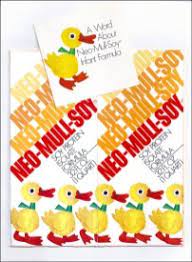
Syntex's hot product that year was Neo-Mull-Soy, a new soy-based baby formula. Advertising for the product featured a cartoon duck named "Davee Duck." 


The organizers of the party had decided that the duck would would be the party's theme. They called him "Davee Duckett," and the program had a picture of Davee wearing a coonskin cap. I remember that audience members got coonskin caps, but that could be a manufactured memory.

The organizers had written a Davee Duckett team-building song. When the band took a break, sheets with lyrics were passed around, and the master of ceremonies led the audience in singing this song, to the tune of Disney's "Ballad of Davy Crockett":

Let me tell you a story I knowed
About Davee Duckett and the way that he's growed

The story's short but the product stands tall
Because he's made us
The winner of them all

Davee, Davee Duckett!
Neo-Mull Soy Boy!

I think there were more verses, but this one has stuck with me for 45 years.

In case you are too young to remember, here is Fess Parker singing the original song, which was the theme to Disney's "Davy Crockett" TV series. Fess played the lead role in the series. If you grew up in the US in the late 1950s, you will remember the song, and the coonskin caps that just about every little boy had.


The original "Ballad of Davy Crockett" actually has twenty verses. The lyrics are something that the Disney Corporation would probably rather forget, as they are insulting to Native Americans. But the internet has a long memory; here are all 20 verses.

If you would like to know the actual history of Davy Crockett (1786-1836), here is the Wikipedia entry. He did fight the "Injuns" in the Creek War of 1813, but we should also note that to his credit, as a member of the US House of Representatives in 1830, Crockett did vote against Andrew Jackson's Indian Removal Act.

I'd like to close this post on a cheerful note, but the Davee Duckett story doesn't have a happy ending. Contrary to the team-building song, Neo-Mull-Soy was not a "winner" for Syntex, and the product does not "stand tall." Neo-Mull-Soy was discovered to cause severe health problems in infants. Here is a CDC report

In 1979 the product was removed from the market, and Syntex became the target of a $2 billion class-action lawsuit. I can't find any record of how this suit was settled, although in a separate suit against Syntex in 1985, plaintiffs were awarded $27 million. A recent writeup of the Neo-Mull-Soy debacle can be read here

In 1984, Syntex cancelled the trademark for "Davee Duck." It's available, if you want it. Davee Duck rag dolls, part of the original advertising campaign, are also still occasionally available.
 

Jul 4, 2022

"Chega de saudade" and "Saxofone, por que choras"

 A few days ago I was playing through the classic choro "Saxofone, por que choras," and had a sudden flash of realization: The harmonic structure of the A section of "Saxofone" is basically the same as the A section of Jobim's "Chega de saudade." I thought this might be worth a blog post.

There are a lot of great versions of "Saxofone" on Youtube. Here are just three of them. 

The 1944 original by the composer, Ratinho:


A modern version by Nailor Proveta:


A cool live version on accordion, by Dominguinhos:


Anyway, the harmonic structure of the "Saxofone" and "Chega" A sections are same in their broad outlines, though "Chega" does have some substitutions and additions. Here's the basic structure of "Saxofone." Compare it to the chords in "Chega" from any fakebook.

Did Jobim consciously lift the chords from the Ratinho tune? It's not unlikely. He certainly used pre-existing chord changes on a number of his other compositions. Does this same chord structure appear in other choros? If any reader spots one, please let me know.

In the book Bossa Nova: The Story of the Brazilian Music That Seduced the World, Ruy Castro describes how Jobim came to write "Chega de saudade" in 1956:

Jobim had written it almost on a whim - a short time before, at the home of Dona Nilza, his mother, he watched the maid sweeping the living room and softly singing a chorinho. He was impressed with the way the girl managed to sing such a complicated song, in 3 parts [note: Ruy Castro meant "3 sections"], when the large part of what one heard on the radio fit into a single musical phrase. He decided then and there that he would also write a chorinho like that.

Weeks later, at his family's place in Poco Fundo, near Petropolis, he got the idea for "Chega de saudade," and when he reviewed what he had written, he realized he had created a kind of samba-canção in three parts, but with a chorinho flavor...


Some comments: 

In referring to 3 "parts," or sections, Ruy Castro is referencing the fact that most choros are composed with a form AABBACCA, or something similar. Each section generally has a key change. "Chega" is in the form ABC, where the A section is 32 bars, the B section is 16 bars, and the C section is the last 22 bars. 

Although I am no expert, I don't hear this piece as a samba-canção. That genre is a slow or medium tempo samba with a sentimental theme. Even the earliest recordings of "Chega" don't have that tempo or feeling.

"Chega de saudade" is often regarded as the first bossa nova. I think of bossa as defined largely by a moderate samba rhythm, employing some North American jazz-style harmony, and played with the guitar style (and vocal style) developed by Joao Gilberto. "Chega" has the essential ingredients: 

•  It was composed by Jobim, using elements of American music such as melodic references to the old standard tune "Bye Bye Blues" in the A and C sections, and to "When You Wish Upon a Star" in the B section. Harmonically, the entirety of the B section of "Chega" is lifted from "When You Wish...". The C section has some bop-like turnaround material in mm. 51-52, and melodic material in mm. 53-57. The song uses a number of II V sequences (although, granted, II V's are not unique to jazz, and it's also true that jazz had influenced choro for decades previously).

•  The first recordings of "Chega" featured Joao Gilberto on guitar; his style was an essential component of bossa. The first recording, by Elizeth Cardoso (on an independent label), did not achieve great popularity. The second recording, by Joao Gilberto (on Odeon, a major label) became a hit. Gilberto's understated vocal style was another defining component of bossa.


Here are some versions of "Chega" that are worth checking out.

The first 1958 recording, by Elizeth Cardoso:


The subsequent 1958 hit recording by Joao Gilberto:


The 1963 recording by Jobim on his first U.S. album, The Composer of Desafinado Plays:


The 1995 recording by Joe Henderson and Herbie Hancock, on Joe's album Double Rainbow:


About the title: Jon Hendricks wrote English-language lyrics in the 1960s, and gave it the title "No More Blues." It's a pretty good choice for the title. "No More Blues" is a rough translation of "Chega de saudade," and also reminds me of "Bye Bye Blues." Perhaps Hendricks noticed the melodic similarity. I don't so much care for the English lyrics, though.

Vinicius de Moraes wrote the original Portuguese lyrics shortly after Jobim finished writing the song. According to Ruy Castro,

Years later, Vinicius said that one of the most difficult set of lyrics he had written had been those of "Chega de saudade," due to the arduousness of trying to fit the words into a melodic structure with so many comings and goings.

This song would obviously be challenging to sing. Mar Vilaseca does a great job on this track, and the band is terrific: